دایره المعارفهای اینترنتی
+ نوشته شده در یکشنبه ۲۹ آبان ۱۳۸۴ ساعت 16:27 توسط عضو هیات علمی
|
Map showing Lorestan in Iran Lorestan or Luristan comprises a province and an historic territory of western Iran south of the Zagros Mountains. The center of the Lorestan Province is the city of Khorramabad. The famous Falak-ol-Aflak Castle is situated inside this city.
In the wider sense (as its name implies), "Luristan" refers to the land of the Lurs, namely that part of western Persia bounded by Iraq on the west and extending for about 400 miles on a northwest to southeast axis from Kermanshah to Fars, with a breadth of 100 to 140 miles. The terrain consists chiefly of mountains, with numerous ranges running northwest to southeast. The central range has many summits which almost reach the line of perpetual snow, rising to 13,000 feet and more, and it feds the headwaters of Iran's most important rivers, as the Zayendeh-rud, Jarahi, Karun, Dix, Abi, Kerkheh. Between the higher ranges lie many fertile plains and low hilly, well-watered districts.
Lur man in traditional clothing, 1921 Ethnologists classify the Lurs as aboriginal Persians. Their language, called Luri, is closely related to Persian, and there two distinct dialects of this language. Lur-e-Bozourg (Greater Lur), which is spoken by the Bakhtiaris, and Lur-e-Kuchik (Lesser Lur), spoken by the Lurs themselves. Prior to the 20th century the majority of Lurs were nomadic herders, with an urban minority residing in the city of Khorramabad. There were several attempts by the Pahlavi governments to encourage the nomadic segment of the Lur population to settle down. By the mid-1980's the vast majority of Lurs had been settled in towns and villages throughout the province, or had migrated to the major urban centres.
In the Northern part of Luristan, formerly known as Lurikuchik (Little Luristan), live the Feili Lurs, divided into the Pishkuh (cis-montane) Lurs in the east and Pushtkuh (ultra-montane) Lurs in the west adjoining Iraqi territory. Little Luristan maintained its independence under a succession of princes of the Khurshidi dynasty, and called atabegs, from 55 to the beginning of the 17th century when Shah Abbas I removed the last atabeg, Shah Verdi Khan, and entrusted the government of the province to Husain Khan, the chief of a rival tribe, with the title of vali in exchange for that of atabeg. The descendants of Husain Khan retained the title as governors of the Pushtkuh Lurs, to whom only the denomination of Feili now applies.
The Southern part of Luristan, formerly known as Lur i Buzurg (Great Luristan) comprises the Bakhtiari division of the province of Khuzestan and the districts of the Mamasennis and Kuhgilus which belong to Fars. Great Luristan formed an independent state under the Fazlevieh atabegs from 1160 until 1424. Its capital, Idaj, survives as mounds and ruins at Malamir, 60 miles southeast of Shushtar.
لطفا برای مطالب بیشتر از آرشیو وبلاگ بازدید فرمایید
Click on the audio symbol below. Read and listen to the list as many times as you want and then try to read the list by yourself.

Click on the audio symbol below. Read and listen to the correct spelling of the words below. Once you have listened try to repeat the spelling by yourself.
| |||||||
Love is what we are born with. Fear is what we learn. The spiritual journey is the unlearning of fear and prejudices and the acceptance of love back in our hearts. Love is the essential reality and our purpose on earth. To be consciously aware of it, to experience love in ourselves and others, is the meaning of life. Meaning does not lie in things. Meaning lies in us.
Marianne Williamson
A friend does most of these:
(A)ccepts you as you are
(B)elieves in "you"
(C)alls you just to say "HI"
(D)oesn't give up on you!
(E)nvisions the whole of you (even the unfinished parts)
(F)orgives your mistakes
(G)ives unconditionally
(H)elps you
(I)nvites you over
(J)ust "be" with you
(K)eeps you close at heart
(L)oves you for who you are
(M)akes a difference in your life
(N)ever Judges
(O)ffer support
(P)icks you up
(Q)uiets your fears
(R)aises your spirits
(S)ays nice things about you
(T)ells you the truth when you need to hear it
(U)nderstands you
(V)alues you
(W)alks beside you
(X)-plains thing you don't understand
(Y)ells when you won't listen and
(Z)aps you back to reality
|
If you can keep your head when all about you If you can dream and not make dreams your master If you can make one heap of all your winnings If you can talk with crowds and keep your virtue |
You are the candle , love's the flame
A fire that burns thrugh wind and rain
Shine your light on this heart of mine
Til the end of time
You came to me like tha dawn through the night
Just shining like the sun
Out of my dreams and into my life
You are the One , you are the One
( I : ) Said I loved you but i lied
Cause this is more than love i feel inside
( I : ) Said I loved you but I was wrong
Cause loved could neverever feel so strong
( I : ) Said I loved you but I lied
With all my soul I've tried in vain
How can mere words my heart explain
This taste of heaven so deep so true
I've found in you
So many reasons in so many ways
My life has just begun
Need you forever , I need you to stay
You are the One , you are the one
( I : ) Said i loved you but I lied
Cause this is more than love I feel inside
( I : ) Said I loved you but I was wrong
Cause loved could neverever feel so strong
( I : ) Said I loved you but I lied
Dont forget , You are my own love for ever
To be, or not to be: that is the question:
Whether 'tis nobler in the mind to suffer
The slings and arrows of outrageous fortune,
Or to take arms against a sea of troubles,
And by opposing end them? To die: to sleep;
No more; and by a sleep to say we end
The heart-ache and the thousand natural shocks
That flesh is heir to, 'tis a consummation
Devoutly to be wish'd. To die, to sleep;
To sleep: perchance to dream: ay, there's the rub;
For in that sleep of death what dreams may come
When we have shuffled off this mortal coil,
Must give us pause: there's the respect
That makes calamity of so long life;
For who would bear the whips and scorns of time,
The oppressor's wrong, the proud man's contumely,
The pangs of despised love, the law's delay,
The insolence of office and the spurns
That patient merit of the unworthy takes,
When he himself might his quietus make
With a bare bodkin? who would fardels bear,
To grunt and sweat under a weary life,
But that the dread of something after death,
The undiscover'd country from whose bourn
No traveller returns, puzzles the will
And makes us rather bear those ills we have
Than fly to others that we know not of?
Thus conscience does make cowards of us all;
And thus the native hue of resolution
Is sicklied o'er with the pale cast of thought,
And enterprises of great pith and moment
With this regard their currents turn awry,
And lose the name of action. - Soft you now!
The fair Ophelia! Nymph, in thy orisons
Be all my sins remember'd.
=============================================
چند شعر دیگر
Approaching any theoretical text for the first time can be daunting – especially in a course where you cannot rely on a professor’s lecture to highlight its main arguments. What follow are seven strategies to help you to learn to read texts without the aid of an interpreter.
1. What is the main argument or plot of the book/article?
Sometimes it is not so easy to tell what the main point is that an author is trying to convey: there is not always a simple thesis statement in the text. One strategy for finding the answer is to read introductions and conclusions with special care. What does the author say she is arguing? How does she set up her argument?
2. Read the title and subtitle of the text, the table of contents, the dedication, and the section headings.
Like reading the introduction and the conclusion, these seemingly unimportant details can give you a great deal of information about the main argument: how is the argument structured? How is the argument broken down into chapters? Who is the intended audience? This exercise is especially important when you are reading only selections of a book, as will often be the case in this course, because it can help you to see how the piece you are reading fits into the overall book that you aren’t reading.
It is far better to focus on how the argument is structured, and to get a sense of the overall argument, than to try to read every word of the text.
3. Make vocabulary flashcards to keep track of new and important terms.
Vocabulary cards are useful ways of keeping track of how a single term (such as ‘multiculturalism’ or ‘liberalism’) is used differently in different places in a single text. They are also useful ways of tracking differences among authors in how they deploy similar terminology with dissimilar meanings.
Vocabulary cards can also be useful ways of learning how to speak the language of the discipline that you are studying. Write down unfamiliar words, or words that are being used in strange ways. If you cannot figure out the definition of the term from the text, then ask your teacher about it. Academese is nobody’s native tongue; there is no shame in being unfamiliar with it.
4. Read for tone, style, and method.
Pay attention to how an author makes her argument. The clues about how an argument gets made can help to make sense of why the argument is or is not successful, and they can give you more information about what the argument actually is.
What is the tone of the text? Is it: personal, polemical, abstract, passionate, argumentative, conciliatory? Why do you think the author is using that tone?
What is the style of the text? Is it: journalistic, academic, narrative? Why has the author adopted that style?
What is the methodology used in the text? How does the author substantiate her claims? What counts as a strong argument for her? On what grounds does she dismiss other arguments? What enables the author to see the issues from her argumentative perspective? Why has the author adopted that method?
5. Think about the Political Context of the Text
When was the text written? Why was the text written then? Does the author refer to any historical or contemporary events which might be relevant in interpreting her argument? Are there aspects of the author’s personal biography which might help to make sense of the text?
6. Contextualize the Text
How does this text fit in with the other texts we read this week? Where does this author converge and diverge from the other authors?
How does this text fit into the course as a whole? Into the genre or discipline (i.e. political theory)?
7. Think about the Author’s Grand Project
How does this text fit in with other works by the same author that we have read? Is the author consistent from one text to the next? If so, how can thinking about the other texts we have read help to illuminate this one? If not, what accounts for the inconsistencies?
دردسرهاى يك زندگى شهرى...
زندگيهاى امروز مردم، به سبب تناسبات پيچيده و گستردهى روزمرهى شهر، آنقدر پر از مشكل و دستانداز و دشواري شده كه كمتر كسي مىتواند ادعا كند در زندگي خود، از پشتوانههاي قوي مادي و معنوي برخوردار است و با امنيت كامل، مىتواند به امرار معاش و زندگي بپردازد. گذشته از قيمت سرسامآور كالاها و مواد غذايي، خوراك و پوشاك و در كل مايحتاج روزانه، اتفاقات و پيامدهاي ناگواري كه در طول زندگي براي خانوادهها رخ مىدهد و آنها را از هدف و مقصد اصلي خود كه آرامش و سعادت در زندگي است، دور مىكنند، از جمله عواملي هستند كه باعث مىشوند تا هيچگاه نتوان زندگي شهري را، يك زندگي آرام و بيدغدغه و كمدردسر ناميد.
جدا از اتفاقات گوناگون و رنگارنگي كه هر روز رخ مىدهند و رنگ بدبختي و مصيبت را به يك شكل، براي مردم نمايان مىسازند، دردسرهاي يافتن يك شغل و فعاليت آبرومندانه كه بتواند ممر درآمدي براي خانوادههاي متوسط به پايين به شمار برود و دشواريهاي گذشتن از هفت خان استخدام در اين اداره و آن شركت، حتي در نازلترين سمتهاست كه باعث شده تا تفاوتهاي بين زندگي در شهر و روستا، به خوبي نمايان شود.
شايد روستاها و دهستانهاي دورافتاده، به سبب اينكه از اتفاقات و پيامدهاي مختلف و عجيب شهرها به دورند و در مركز توجهها و نقطهي اصلي رويداد اتفاقات گوناگون قرار ندارند و خانوارها نيز به سبب جمعيت و وسعت كم اين دست روستاها، روابط نزديك و تنگاتنگي با هم دارند و كوچكترين سوانح و رويدادهاي خوشيمن و ناگوار، از نظر كل اهالي دور نمىماند، مشكلاتي را كه يك شهرنشين كمدرآمد، در اوج دود و گرما و آلودگيهاي صوتي و گرفتاريهاي خاص اجتماعي و اقتصادي و وقايع مختلف سياسي فرهنگي مهم با آنها سردرگريبان است، نداشته باشند و به راحتي بتوانند از پس مخارج و سختيهاي زندگي و امرار معاش بربيايند اما مشكل اينجاست كه زندگي در شهر، نه تنها شامل گرفتاريها و تنگناهاي مالي و اقتصادي مىشود، خيل عظيمي از ناراحتيها و سيل گستردهيي از امواج منفي روحي و معنوي را نيز با خود يدك مىكشد.
گذشته از موانع و دردسرهاي يافتن مشاغل مناسب در شهرهاي بزرگ و پرجمعيت، كه مانع و عامل اصلي عدم موفقيت جوانان در تامين مالي خانوادههايشان به شمار مىرود، افزايش سرسامآور قيمت توليدات مختلف صنعتي و خوراكي كه قدرت خريد براي خانوادهها را تا حد بسياري پايين مىبرد، نقش عمدهيي در گسترش فقر و بيكاري در جامعه ايفا مىكند.
هرچند كه نبايد در مورد دردسرهاي يك زندگي شهري، از موانع و سدهاي روحي و رواني يك زندگي آرام و بدون تنش در شهر غافل شد. آلودگيهاي مختلفي كه در شهرهاي صنعتي، بزرگ و پرجمعيت وجود دارند و انواع ناراحتيها و اختلالات روحي و رواني را براي شهروندان ايجاد مىكنند، از جمله عواملي هستند كه زندگي در شهر را از هرجاي ديگر، سختتر و دشوارتر مىسازند. آلودگيهاي صوتي، آلودگي آب و هوا و آلودگيهاي اطلاعاتي، از جمله مواردي هستند كه در چرخهي صعبالعبور ساختن عبور از جادههاي زندگي شهري، نقش به سزايي دارند.
علي يوسفكمالي كه از روستاهاي اطراف شهر، به رشت آمده و شغلي غير از باربري نيز ندارد، در مورد وضعيت خود مىگويد: "شايد برايتان جالب باشد كه من در سن 45 سالگي و در حالي كه فوقديپلم رياضي دارم، مجبورم با دو فرزند و يك وضعيت خيلي دردناك، روزي بيش از 7 ساعت در خيابانهاي شلوغ و پردود و دم رشت، بار اين خانواده و آن خانواده را ببرم و شايد روزي حداكثر 5000 تومان درآمد كسب كنم. من كه نمىتوانستم بيكار بمانم اما شما فكر مىكنيد كار بهتري براي فوقديپلم رياضي با 45 سال سن وجود ندارد؟؟"
فريدون گلگلاب نيز كه در گوشهيي از خيابان سعدي، مشغول فروش تمشك بود، معتقد است: "من به بيش از 10 جا براي كار و شغل مراجعه كردم و هيچ كس هم مرا نپذيرفت. انگار كه مديران و روساي شركتهاي مختلف، به كارگران جديد اعتماد ندارند و فكر مىكنند كه ما برايشان در آينده دردسر درست ميكنيم. البته من فكر مىكنم با اين وضع فعلي نيز حق دارند و ترجيح مىدهند بدون وردست كار كنند تا اينكه كارگر بگيرند و مجبور شوند بعد از مدتي، مقدار زيادي ضرر كنند. حتي همين فروش تمشك هم مقدار زيادي دردسر دارد و سادهترين كارها هم در شهر، كلي مانع و مشقت دارند."
اما در مورد دردسرهاي يك زندگي شهري، دكتر رسول اسماعيلي، كارشناس مسايل اجتماعي، مىگويد: "افزايش جمعيت، تخصصي شدن مشاغل و گسترش شهرها، باعث شده تا زندگي و گذران معيشت، مثل گذشته آسان و ساده نباشد. نخست اينكه امروزه هيچكس نمىتواند بدون داشتن شغل ثابت و مطمئن، به آيندهي كاري مطمئن، تكيه داشته باشد. به همين دليل، برخورداري از مدارج تحصيلي بالا و مناسب و داشتن تخصصهاي فني و علمي، از جمله معيارهاي اصلي و مهم كارفرمايان براي استخدام نيروهاي تازهكار به شمار مىرود. هرچند كه شرايط جامعهي ما و ظرفيتهاي شغلي، باعث مىشود تا حتي بسياري از دكترها و مهندسهاي ما نيز بيكار باشند و نتوانند خود را متكي به هيچ پشتوانهي مالي قدرتمندي ببينند. با وضع فعلي جامعهي ما نيز هيچكس نمىتواند انتظار داشته باشد كه گوشهيي بنشيند و لقمهيي نان حلال، برايش به ارمغان بيايد هرچند كه در هيچ جاي دنيا اينطور نيست اما بايد اطمينان داشت كه جامعهي ما با توجه به گذار از مراحل ابتدايي پيشرفت، هنوز راه زيادي براي موفقيت در اشتغالزايي دارد و نخستين گام نيز اعتمادسازي براي كارگران و كارفرمايان، با تصويب قانونهايي جهت تامين پشتوانهي مادي و معنوي كارگر و در كنار آن، كارفرماست كه بتواند با طيب خاطر، عناصر جديد را به كار بگيرد و از عواقب استخدام نيروهاي جديد نيز ابايي نداشته باشد.
هرچند علاوه بر مشكلات اشتغال و درآمدزايي براي خانوادههاي تازه شكل گرفته و جواناني كه براي كار به شهرها مىآيند، برخي مشكلات فراگير و جهاني زندگي در شهرها نيز وجود دارند كه باعث مىشود تا يك شهروند، هيچگاه نتواند با آرامش خاطر، به فرداي آسوده و بيتنشي بيانديشد اينها مشكلاتي هستند كه كم و بيش اتفاق مىافتند اما باعث مىشوند تا زندگي در شهر، پرمخاطرهتر، ناامنتر و پردردسرتر از هرجاي دنيا باشد. جايي كه يك شهروند، يك كارمند اداره و يك كارگر ساده نيز نمىتوانند نسبت به فرداي خود در زمينهي شغل و درآمد و كانون خانواده، اطمينان كامل داشته باشند و بايد نسبت به فرداي خود، همواره با ديدهي احتياط و ترديد بنگرند."
شهر، جايي است كه درآمدهاي آن، بين صدهاهزار نفر تقسيم مىشود. جايي كه كمتر پيش مىآيد همگي متمولترين باشند و يا همگي مفلسترين. جايي كه همه چيز در اعتدال پيش مىرود. حتي درآمدها و امنيتهاي جاني و مالي و شغلي و در بسياري از موارد نيز اين اعتدالها، رو به سقوط و نزول هستند.
شهر، جايي است كه هرجاي آن را نگاه كني، برج و بارو مىبيني، دود و دم مىبيني و ماشين و تراكتور و تريلي هجده چرخ. جايي كه در هر گوشهي آن، كارخانهيي است با فلانهزار متر وسعت. جايي كه مردم، حتي كمتر وقت مىكنند حال همديگر را بپرسند. جايي كه ماراتن نفسگير زندگي، به اوج خود مىرسد. همگي سعى مىكنند تا هرطوري شده، از خط پايان عبور كنند، حتي با پاي شكسته. جايي كه شام هر شب، براي بسياري از خانوادهها، به معضل و مشكلي تبديل مىشود و جايي كه از سوي ديگر، براي بسياري از خانوادهها، تعداد بنزهايي كه قرار است در پاركينگ، پارك شوند.
شهر، جايي است كه عدهيي در آن، از فرط بدبختي و فلاكت، رو به خيابانخوابي و آوارگي مىآورند و عدهيي ديگر، آسمانخراشهاي خود را روز به روز افزايش مىدهند و كل هزينهي خريد يك آپارتمان را، به عنوان پول توجيبي، به فرزند خود مىسپارند.
شهر، جايي است كه شما در آن، حتي در بعضي از روزها و شبها و در اوج التهاب و شلوغي و سردرگمي، در اوج خستگي و كلافگي از دردسرها و مشكلات، رو به گريه مىآوريد و قلب خود را، با اشكهايي كه از همانجا سرچشمه مىگيرد، آبياري مىكنيد.
و شهر، اين باغ سبز زيبا، كه به ظاهر، پر از درختها، نهرهاي روان از آب و ميوههاي بينظير است، جايي است كه وقتي در آن پا گذاشتي، با بيرحمانهترين سيمهاي خاردار، محاصرهات مىكنند و زنداني مىشوي تا محكوم باشي يا به فناي مطلق و يا به موفقيت كامل در عرصهيي كه در آن، حتي از فرداي خود نيز مطمئن نيستي. پيچيدگيهاي نامهربان زندگي در شهر، شايد براي آنهايي كه در شهرنشيني خبره شدهاند و با تمام موانع امرار معاش در شهر آشنا هستند و براي خود، ديگر به استاد مواجهه با مشكلات نيز تبديل گشتهاند، خيلي سخت نباشد هرچند كه آنقدر ناملايمتها دارد كه شهريترين آدمها را نيز دچار اضطراب و التهاب مىكند اما براي آنهايي كه از فرط سادگي، رو به جايي مىآورند تا به قول خودشان بتوانند پلههاي ترقي را آنجا طي كنند، مىتواند جنگلي تاريك باشد، پر از گرگهاي وحشي كه هر كدام از آنها، به انتظار فرصتهايي نشستهاند تا از راه، به درت كنند. در مورد دردسرهاي زندگي شهري، حرف و حديث زياد هست.
شهر، جايي است كه روستا نيست. روستا كه در آن، صفا و همدلي در كار و دوستي و مودت در جديترين عرصهها، حرف اول را مىزند. جايي كه خبر از مناسبات رياكارانهي معمولي دنيوي در آن نيست....
|
جستجوي تصوير در Google با داشتن بيش از 250 ميليون تصوير قابل مشاهده در فهرست خود، جامعترين مجموعه در کل وب مي باشد.براي استفاده از جستجوي تصوير به صفحه جستجوي پيشرفته و يا http://www.google.com/imghp?hl=fa برويد و عبارتي را در جعبه جستجوي تصوير وارد کنيد و سپس دکمه جستجو را انتخاب کنيد.در صفحه نتايج تصوير کوچک شده را انتخاب کنيد تا روايت بزرگتري از تصوير و همچنين صفحه اي که تصوير در آن قرار دارد را مشاهده کنيد. (يادداشت:براي دسترسي زبان انتخابي شما بايد در صفحه قابليتها انگليسي انتخاب شده باشد.)
تصاويري که توسط سرويس Google Image Search مشاهده مي کنيد ممکن است که کپي رايت داشته باشند.هرچند که شما مي توانيد آنها را از طريق سرويس ما بيابيد و يا مشاهده کنيد، ما به شما هيچ حقي نمي توانيم بدهيم جز حق مشاهده آنها از طريق وب.از اينرو اگر مايل به استفاده از هر يک از تصاويري هستيد که به وسيله سرويس ما پيدا کرده ايد ما به شما پيشنهاد مي کنيم که با صاحب آن سايت براي اجازه استفاده از تصوير تماس بگيريد.
اخطار:نتايجي که با اين قابليت مشاهده مي کنيد ممکن است شامل مطالب مربوط به بزرگسالان باشد.Google فاکتورهاي خاصي را در نظر مي گيرد براي اينکه مطمئن شود که آيا اين تصوير به مورد جستجوي شما مربوط است يا خير. از آنرو که اين روشها کاملا بي اشتباه نيستند ممکن است در بين تصاويري که مي بينيد تصاوير نا مناسبي هم قرار گرفته باشد.
براي اطلاعات بيشتر در مورد اين قابليت لطفا FAQ جستجوي تصوير را بخوانيد.
Google سد زبان را با قابليت ترجه جديدي (بتا) شکسته است. با استفاده از قابليت ترجمه با ماشين ،Google حالا به انگليسي زبانان قابليت استفاده از بسياري از صفحات غير انگليسي را مي دهد.
اگر جستجوي شما نتايج غير انگليسي داشته باشد يک لينک به صفحه ترجمه شده انگليسي آن در اختيار شما قرار خواهد گرفت.
اگر مي خواهيد چکيده و عنوان اسناد يافته شده برای جست وجوی شمابه انگليسي ترجمه شوند، گزينه ی ترجمه درصفحه ی تنظيمهارا فعال کنيد. با اين کار گوگل به صورت خودکار چکيده وعنوان سندهای يافته شده را به انگليسي ترجمه خواهد کرد.
براي اطلاعات بيشتر در مورد اين قابليت لطفا FAQ ترجمهرا بخوانيد.
فهرست سندهايي که گوگل برای پرسش شما مي يابد، اکنون فايلهای PDF.را نيز دربرمي گيرد. نوشتار اين فايلها به هر زبان و خطي که باشد، بدون وابستگي به سيستم عامل، مرورگر و فونت، به صورت کامل در نرم افزار ادوبي آکروبات نمايش داده مي شود. گرچه اينگونه فايلها به اندازه ی سندهای HTML رايج نيستند، اغلب اطلاعات ارزشمندی رادربردارند که در ديگر سندها يافت نمي شود.
برای اين که مشخص شود کدام يافته به صورت يک فايل PDF. عرضه شده است، واژه [PDF] به رنگ آبي روبروی عنوان سند درج مي شود.به اين ترتيب خواهيد دانست که برای نمايش اين سند، نرم افزار Adobe Acrobat Reader اجرا مي شود. روی پيوند عنوان سند کليک کنيد تا به فايل PDF. دست يابيد. (اگر نرم افزار آکروبات در رايانه ی شما نصب نباشد، به صورت خودکار به سايت دريافت رايگان اين نرم افزار هدايت خواهيد شد)
در مورد فايلهای PDF. پيوند آشنای"Cached" جای خود را به "نسخه ی متني" مي دهد. نسخه ی متنی رونوشتي از سند پي دی اف است که همه ی اطلاعات صفحه آرايي آن حذف شده است.
اگر نمي خواهيد سندهای PDF. در فهرست يافته های پرسش شما ارايه شوند، کافيست دستور filetype:pdf- را در کنار پرسش خود درون پنجره ی جست وجو درج فرماييد.
گوگل از هر صفحه يك عكس ذخيره ميكند تا براى زمانى كه صفحه اصلى اگر موجود نبود نسخه پشتيبان داشته باشد. اگر شما برروى لينك Cached كليكى كنيد، صفحه اى را خواهيد ديد كه ما آنرا ضميمه كرده ايم.
وقتى كه صفحه cach شده نشان داده ميشود، اين صفحه داراى يك هدر در بالاى خود است كه در آن قسمت نسخه cach شده را يادآور ميكند. جاهايى كه برجسته شده اند با عث ميشوند تا شما قسمت مورد نظر خود را راحت تر پيدا كنيد.
لينك "ذﺨﻴﺭه شده" براى سايتهايى كه ضميمه نشده اند موجود نخواهد بود، و همينطور اين لينك براى مالكينى كه اين لينك را نخواهند نيز موجود نخواهد بود.
وقتى شما برروى Similar Pages براى ديدن نتيجه يك جستجو كليك كنيد، گوگل به صورت خودكار صفحات مربوط را براى رسيدن به نتيجه اكتشاف ميكند.
لينك "صفحات مشابه" استفاده هاى زيادى دارد. تگر شما محتوى سايت خاصى را در نظر داريد، ولى ميخواهيد كه آن بيشتر خواسته هاى شما را براورده كند، اين لينك ميتواند سايتهاى مشابه بنسبت موضوع شما را نيز ارايه كند.
گوگل صفحات متعددى را براى ميليونها صفخات وب پيدا ميكند. البته چيزى كه مهم است اينست كه صفحه اى كه با موضوع شما درخور باشد پيدا شود. براى مثال، گوگل ممكن است قادر به پيدا كردن صفحات مربوط به home page شخصى شما نباشد، اگر اين صفحات حاوى اطلاعات مربوط به صفحه اصلى نباشند.
كشف كنيد كه چه كسانى به شما لينك هستند
بعضى كلمات، وقتى با يك دونقطه دنبال شوند، يك معناى ويژه اى را براى گوگل خواهند داشت. يكى از ىشترين كلمات براى گوگل عملگر :link است. پرسش link:
| مثال: |
بعضى از كلمات به همراه يك دونقطه برا گوگل معناى بخصوصى را دارند. يكى از اين كلمات عملگر site: است. اين كلمه به همرا آدرس دامين در جلوى آن باعث ميشود تا جستجوى شما فقط در دامين يا سايت معين شده باشد.
براى مثال، جهت جستجو يك خبر در گوگل، وارد كنيد:
| مثال: |
دكمه "I'm Feeling Lucky" شما را مستقيما به اولين صفحه وبى كه گوگل براى چستجوى شما برگردانده است ميبرد. در اين حالت شما نتايج ديگر حاصل آمده از جستجوى خود را ديگر نميبينيد. اين حالت معمولا در زمانى استفاده ميشود كه شما عجله داشته و فقط نتيجه بدست آمده براى شما مهم است.
براى مثال، براى جستجوى وب سايت دانشگاه Stanford، كلمه Stanford را در فيلد جستجو وارد كرده و برروى دكمه "I'm Feeling Lucky" كليك كنيد. سپس گوگل شما را مستقيما به وب سايت رسمى اين دانشگاه در آدرس www.stanford.edu ميبرد.
| مثال: |
احساس خوشبختى ميكنيد!؟
FARS
Fars, the land of virtuous people, the territory of great antiquity, equal to that of the history of Iran, has always been considered as a major center of formation and prosperity of ancient civilizations of Iran and the world. This territory is the cradle of science, culture and civilization and has a meritorious and worthy position in the mind and languages of Iranians and inhabitants of the world.
In the book of Farsnameh Nasseri we read: " Pars is originally, the name of some southern people of Iran whose seat was also called Pars. Two big families of Achaemenides and Sassanides ascended the throne in Iran and the Greeks took the word Persia from the name of these people and applied it generally to all Iran. Thus the word Persia or Perse of which the arabicized form is Fars has generally been applied to all Iran in European languages”.
Fars has a deep and cultural background, where famous men like Molla Sadra, Hafez, Saadi, Sibawayh, Rouzbehan, Ibn-e-Khafif and… have appeared and created eternal cultural, scientific, philosophical, religious and literary works. Fars is the home of learning and house of believers.
Throughout the history, Fars Province area has been exposed to wide changes and that is why its people have various languages, dialects, mores and cultures in general.
FARS Today
The Province of Fars with a surface area of about 133000 sq km, occupies 8.1% of the Country’s total surface area. This province is bounded on north by Esfahan and Yazd provinces, on west by Boushehr, and Kohkilouyeh & Boyerahmad provinces, on south by Hormozgan province and, on east by Kerman province. At present the population of Fars province is about 4000000/- with an average annual growth rate of 2.1%.
The vast province of Fars, is a 4-season province. From the viewpoint of temperature, this province can be divided into three cold, temperate and hot regions. The average temperature in the coldest month of the year varies between -7 to -2 degrees centigrade, and in the hottest month of the year between 35 to 40 degree centigrade.
On the basis of the last divisions of the country, the province of Fars has 18 townships,61 districts,184 rural district, 54 cities,2982 villages, 2118 independent farms,2153 subordinate farms, 661 independent places and 94 subordinate places. On the basis of the studies performed , in the whole Fars province, it has been about 288 tourist centers with historical - religious, natural and historical-natural attractions, out of which 148 centers are with historical-religious and 125 centers with natural and 15 centers with historical-natural attractions. What follows tends to introduce only a part of these attractions.
This town is situated in the south of Fars province and has an area of 21281 sq km. The climate of the town is hot. The territory of Lar has drawn attentions since Sassanian dynasty by creation of a fire-temple in Karian. At the end of 8th century, it was the center of coinage, and the coin of Lar by the name of Larin was current on Persian Gulf coasts and India.
Tourist sites: mausoleum of Shaykh Abdossalam in Khonj, Shaykh Danial Mausoleum and the tombs of Khonj Shaykhs, Neshat Garden of Lar, Caesarea Bazar, Lar Jame’e Mosque, Aqa Cistern, Gerash Seven Cistern, two caravanserais opposite Bazar, Ejdeha Peykar Fort, Qadamgah Fort, Pir Sorkh Mausoleum, Imamzadeh Mir Hamzeh, Imamzadeh Beriz , Abbas Bridge and Harmude protected zone of Lar.
Shiraz city situated in the center of Fars province and has an area of 10688sq.km. Shiraz is a pleasant fresh and flourishing plain. Although baked clay tables found at Persepolis treasure of Documents, revealed that Shiraz city existed in Achaemenian era, but substantial development of Shiraz has been realized in
post-Islamic era.Tourists Sites Of SHIRAZ : Shiraz is the city of poetry, beauty and virtue, and is the territory of philosophy and ethic. It is the city of garden, orange groves and poppies, and has many things to see.
Holy Shrines:
Mausoleums:
Mosques:
Gardens:
Museums:
Historical Monuments:
Monuments of the Districts of SHIRAZ :
This town is situated in the south of Fars province and has an area of 5683 sq km. The climate of this town is hot and its products are: cereals, grains and grenade.
Tourist sites: Afifeddin mausoleum, Pirmobarak Shrine, Tel-e-Birom, Ashkenan Ancient Bath, Fal Historical Cemetery
| ارزش | Value! |
| ارزش يک خواهر را،از کسي بپرس که آن را ندارد. | To realize The value of a sister Ask someone Who doesn't have one. |
| ارزش ده سال را،از زوج هائي بپرس که تازه از هم جدا شده اند. |
To realize The value of ten years: Ask a newly Divorced couple. |
| ارزش چهار سال را،از يک فارغ التحصيل دانشگاه بپرس. | To realize The value of four years: Ask a graduate. |
| ارزش يک سال را،از دانش آموزي بپرس که در امتحان نهائي مردود شده است. |
To realize The value of one year: Ask a student who Has failed a final exam. |
| ارزش يک ماه را،از مادري بپرس که کودک نارس به دنيا آورده است | To realize The value of one month: Ask a mother who has given birth to a premature baby. |
| ارزش يک هفته را،از ويراستار يک مجله هفتگي بپرس. |
To realize The value of one week: Ask an editor of a weekly newspaper. |
| ارزش يک ساعت را،عاشقاني بپرس که در انتظار زمان قرار ملاقات هستند. |
To realize The value of one hour: Ask the lovers who are waiting to meet. |
| ارزش يک دقيقه را،از کسي بپرس که به قطار، اتوبوس يا هواپيما نرسيده است. |
To realize The value of one minute: Ask a person who has missed the train, bus or plane. |
| ارزش يک ثانيه را،از کسي بپرس که از حادثه اي جان سالم به در برده است. |
To realize The value of one-second: Ask a person who has survived an accident. |
| ارزش يک ميلي ثانيه را،از کسي بپرس که در مسابقات المپيک،مدال نقره برده است. |
To realize The value of one millisecond: Ask the person who has won a silver medal in the Olympics. |
| زمان براي هيچکس صبر نمي کند. قدر هر لحظه خود را بدانيد.قدر آن را بيشتر خواهيد دانست، اگر بتوانيد آن را با ديگران نيز تقسيم کنيد. |
Time waits for no one. Treasure every moment you have. You will treasure it even more when you can share it with someone special. |
| براي پي بردن به ارزش يک دوست،آن را از دست بده. |
To realize the value of a friend: Lose one. |
| اين نوشته را به دوستان خود يا هر کسي که برايش آرزوي خوشبختي داريد، ارسال کنيد. صلح، عشق و کاميابي ارزاني همگان باد. | Forward this letter to friends, to whom you wish good luck. Peace, love and prosperity to all |
|
بهترین نسخه دیکشنری |
|
گرانترین نسخه دیکشنری Babylon که به نام نسخه Babylon Pro 5.0.5 + Oxford مشهور شده است. دیکشنری مناسب برای کامپیوتر شما که میتوانید با یک کلیک بر روی هر کلمه ترجمه و همچنین طرز تلفظ آنرا بفهمید. در داخل سایتش هم در مورد این نسخه زیاد توضیح نداده است به جز اینکه نوشته است بدون محدودیت از این نسخه میتوانید استفاده کنید. قیمت این نسخه نزدیک به 80 دلار است که میتوانید به رایگان دریافت کنید. [User: emporu | S/N: 3XQFFG5YUAKACJYR2S8J6KFMUD0PKMY4] حجم: ۲۰ مگابایت |
http://www.behindthename.com/nmc/eng.php
فرانسوی
http://www.behindthename.com/nmc/fre.php
آلمانی
http://www.behindthename.com/nmc/ger.php
ایتالیایی
http://www.behindthename.com/nmc/ita.php
اسپانیولی
http://www.behindthename.com/nmc/spa.php
عربی
http://www.behindthename.com/nmc/ara.php
هندی
http://www.behindthename.com/nmc/ind.php
ایرلندی
http://www.behindthename.com/nmc/iri.php
آفریقایی
http://www.behindthename.com/nmc/afr.php
|
|
Run it up the flagpole, BPO, monetize. What do these terms mean and where did they come from? They are just three terms used in business and in the high-tech world. That's what this web site is all about.
This project got its start with the realization that there are no web sites that focus on the etymology and usage of business and high-tech jargon terms. There are many business jargon glossary sites, but none that apply rigorous lexicographic standards to the subject.
The world of business, and particularly high-tech business, is fertile ground for neologisms and catch phrases. General and slang dictionaries do not cover many of these terms, either because they are used in too limited a context or because they appear faster than print dictionaries can react. The internet is the ideal medium for capturing these terms and describing how they are used. Not only can a web site respond to new terms and phrases much faster than a print source, but it can also rely on a web of contributors to expand the dictionary and provide citations of usage.
This is very much a work in progress. The actual dictionary entries are few in number at present, but the number will grow. Also to be determined is the eventual fate of the collection. Whether this material will find its way into print is unknown, as is the form such publications might take.
This project is part of Wordorigins.org.
This is the list, some 400 words and phrase origins. The words and phrases are selected because their origins are inherently interesting or because some bit of folklore, sometimes true and sometimes false, is associated with the origin. The etymologies of common words with straightforward explanations can be found in any good dictionary and I do not attempt to reproduce them here. Many, if not most, of the words have been added as a result of questions or suggestions from readers of the site.
Various sources have been used to compile the information contained in these pages. These are excellent references for further study.
The symbol means that the entry is new or has recently been substantially updated.
What is etymology? H. Rex Hartson
What is etymology? fun-with-words
Where do languages come from? Merritt Ruhlen
Language Contact: Terms Eva Easton
Language Varieties Univ. of New England, Australia
Vocabulary H.W. Fowler
Word Formation Johanna Rubba
Word Formation Take Our Word
What is linguistics? Stu Barton
Linguistics Course Alan Ramsay
Linguistics Course Sharon Clampitt
Linguistics Overview William Harris
Linguistics Phonetics & Phonology
Linguistics Terms Brian Zahn
Etymological Dictionary Eugene Cotter
Language Families Ethnologue
Indo-European Languages Cathy Ball
Indo-European Languages Jack Lynch
Indo-European Languages cognates / Kelley L. Ross
Indo-European Languages TITUS / Univ. of Franfurt
Germanic Languages softrat.home.mindspring.com
Language Identifier Doug Beeferman
Mini Essays about Language bluemarble.net/~langmin
While many words in English have been inherited from older stages of the language, many more words have come into it by other means. Indeed, we are always adopting new words into English, and below are described some of the methods and general word formation processes by which this is done.
Acronyms: These words are formed by taking the initial sounds or letters of the words of a phrase and uniting them into a combination that is itself pronounceable as a separate word. Thus NATO is an acronym for North Atlantic Treaty Organization, laser for light amplification through the stimulated emission of radiation, and radar for radio detection and ranging.
Backformation: Backformation makes use of a process called analogy to derive new words, but in a rather backwards manner, that is from an older word that is mistakenly assumed to be a derivative of it. For example, we have words such as revision and revise and supervision and supervise. Revision is formed by regular derivation from revision + ion. When television was invented, the verb televise was back formed on the basis of analogy with revision and revise, that is:
revision : revise :: television : X
To cite another example, the verb donate was formed on the basis of pairs such as creation—create. We borrowed donation from French and back formed donate.
creation : create :: donation : X
Another example, in the original the final consonant [-z] of pease is not, as it seems to the ear to be, the English plural suffix –s. It is, in fact, not a suffix at all. But by the 17th century, pease was mistaken for a plural, and a new singular, pea, was derived from a word that was itself a singular, precisely as if we were to derive a form *chee from cheese under the impression that cheese was plural; then we should have one chee, two cheese just as we have one pea, two peas.
One very regular source of back-formed verbs in English is based on the pattern: worker—work. The assumption seems to have been that if there is a noun ending in –er (or something close in sound), then we can create a verb for what noun –er does. Hence, an editor must edit, a sculptor must sculpt, and burglars, peddlers, and swindlers must burgle, peddle, and swindle.
Blending: A blend is a combination of the parts of two words, usually the beginning of one word and the end of another: smog from smoke and fog, brunch from breakfast and lunch, and chortle from chuckle and snort. (Lewis Carroll invented this blend, and his poem “Jabberwocky” contains several other examples of interesting blends. Carroll called them “portmanteau words.”)
Borrowing: Foreign words are always being “borrowed” into other languages, especially to accompany new ideas, inventions, products, and so on. When speakers imitate a word from a foreign language and at least partly adapt it in sound or grammar to their native speech patters, the process is called “borrowing,” and the word thus borrowed is a “loanword.” A few examples: alcohol (Arabic), boss (Dutch), croissant (French), lilac (Persian), piano (Italian), pretzel (German), robot (Czech), tycoon (Japanese), yoghurt (Turkish), zebra (Bantu).
A special type of borrowing is described as “loan-translation” or “calque.” In this process, there is a direct translation of the elements of a word into the borrowing language. For example: English hot dogs becomes Spanish perros calientes, English skyscraper becomes French le gratte-ciel.
Clipping: Frequently we shorten words without paying attention to the derivational morphology of the word (or related words). We see here again the element of reduction, already seen in blending. Exam has been clipped from examination, dorm from dormitory, and both taxi and cab from taxi cab (itself a clipping from taximeter cabriolet). Because clipping often ignores lexical and morphemic boundaries and cuts instead in the middle of a morpheme, we end up creating new morphemes and enriching the stock of potential building material for making other words.
Coinage: Words may also be created without using any of the methods described above and without employing any other word or word parts already in existence; that is, they may be created out of thin air. Such brand names as Xerox, Kodak, and Exxon were made up without reference to any other word, as were the common words pooch and snob. Also called “root creation.”
Compounding: Two or more existing words are put together to form a new word: blackboard, expressway, and air conditioner. “Amalgamated compounds” are those words in which the compounded elements are so closely welded together that their origins as compounds is obscured. For example, daisy from Old English dQgesēage, “day’s eye,” lord from OE hlaf (‘loaf’) plus weard (‘guardian’), and sheriff from OE scīr (‘shire’) plus rēfa (‘reeve’).
Derivation: As you know, English has a number of derivational morphemes that we use to derive words. There are other prefixes (added to the beginning of a stem) or suffixes (added to the end of a stem). Some of these derivational morphemes change the grammatical function of a word and some do not; they change the meaning of a word. Some common prefixes: re-, dis-, un-, anti-, ante-, in-, pre-, post-, sub-. Some common suffixes are: -ly, -ness, -y, -er, -ity, -ation, -ful, -able, -al.
Conversion or Functional Shift: A new word may be created simply by shifting the part of speech to another one without changing the form of the word—without adding any affixes. Laugh, run, buy, steal are used as nouns as well as verbs, while position, process, contrast are nouns from which verbs have been formed.
Morphological Misanalysis or False/Folk Etymology: Sometimes people hear a word and misanalyze it either because they “hear” a familiar word or morpheme in the word, or for other, unknown, reasons. These misanalyses can introduce words or morphemes. For example, the suffix –burger. (Hamburger is a clipping from Hamburger Steak.) -burger has since been added to other types of foods: cheeseburger, pizzaburger, salmonburger, veggieburger, steakburger. Another example concerns the creation of (a)holic from a peculiar analysis of alcoholic. This suffix can be found in words such as workaholic and chocaholic. Sometimes a phrase is misheard or misanalyzed, resulting in examples such as: pinching needles from pins and needles, take it for granite from take it for granted, chester drawers from chest of drawers.
Proper Names: Many places, inventions, activities, etc., are named for persons somehow connected with them; for instance, lynch by way of Lynch’s Law, from the Virginian captain William Lynch [1742-1820], who led a campaign of “corporeal punishment” against those “unlawful and abandoned wretches” who were harassing the good people of Pittsylvania County. Boycott comes from Captain Charles Cunningham Boycott [1832-1897] who, because as a land agent he refused to accept rents at figures fixed by the tenants, was the best-known target of the policy of ostracization of the Irish Land League agitators. Other unchanged names of actual people: ampere, bloomer, bowie (knife) cardigan, chesterfield (overcoat or sofa), davenport, derby, derrick, derringer, graham (flour), guy, valentine, watt, zeppelin.
Roots
Following is a list of roots for English vocabulary. The list is formatted so that the root with its definition is shown first, then the source of the root (Latin, Greek, etc.) with the source word's definition, and then last is an example of the root as used in a word and the word's definition. The sample words are linked to additional words with the same root.
INDEX: A B C D E F G H J L M N O P Q R S T U V
Back to Vocabulary Workshop Home Page, vocabulary, prefixes, suffixes or exercises.


Morphemes (minimal units of meaning) are of two basic kinds: roots and affixes. While there is not an absolutely sharp dividing line between them, due to the natural, gradual historical progression from root to affix, there are various properties that typically cluster together, thus allowing us to distinguish the two types. For most morphemes, it is clear which class they belong in.
A third type of linguistic element is a function word, which occurs in certain languages like English, which don't have much bound morphology -- that is, languages with lots of free morphemes, instead of mostly words with roots and attached bound morphemes.
In such languages, many grammatical functions are served by function words: small units that have some independence, occuring with more freedom of position than affixes (thus they are somewhat root-like), but which have grammar-like meaning rather than concrete lexical content (which makes them more affix-like). Some function words in English are the, a, he, she, it, if, although, etc.
Function words can be thought of as right in between roots and affixes. Prepositions (like English over, in, through) are sometimes classed as function words and sometimes as roots--because they are, again, intermediate. In form, they are free morphemes. In terms of function, they have (especially in their spatial meanings) more concrete lexical content than most grammatical elements, but their meaning is still rather abstract and relational. (Note that in Greek and Latin, the elements corresponding to the English prepositions are bound morphemes rather than free function words. These are the spatial prefixes such as circum-, meta-, sub-, etc.)
| ROOT > PREPOSITION > FUNCTION WORD > AFFIX |
The elements to the left are more lexical, those to the right are more grammatical.
Fortunately, we don't have to worry about the in-between cases! Probably 99% of all morphemes in English (and Latin and Greek for that matter) are easily identified by the criteria given above as either roots or affixes. Be sure you can tell the difference when looking at the morphemes in ordinary, garden-variety words.
© 2004 Suzanne Kemmer
Roots of English: an Etymological Dictionary* 
by Prof. Eugene Cotter, Seton Hall University
|
Download Instructions**
Downloading Roots of English using Netscape
*This software is for use with Windows 95/98. **The products referenced in this site are provided by parties other than AbleMedia. AbleMedia makes no representations regarding either the products or any information about the products. Any questions, complaints, or claims regarding the products must be directed to the appropriate owner. Click here for usage terms and conditions.
| ||
|
|
Good usage in English is based on a mastery of the meanings, pronunciations, and spellings of words and phrases. The field of English grammar is essential to the proper use of words and is very helpful in avoiding the abuse of English usage.
First, standardization of English spelling is thought to be a result more to the invention of printing than to any other single cause. Prior to the introduction of printing into England by William Caxton in 1475, most people were not concerned with spelling. Reading and writing were activities carried on only by monks and other learned men. As long as people communicated solely by speech, spelling was no problem; but when printing came in, some standards had to be set up. Without some standards, chaos would have resulted because those who read would have been utterly confused by whimsically varied spelling. As larger and larger numbers of people began to read and to write, they saw and used the standardized spellings employed by scholars, "editors", and printers. These standards were loose and flexible, to be sure, but they represented a forward step in communication. This unification of the language, though partial and imperfect, had a profound effect on writing but not, of course, on speech.
Second, it is believed by some scholars that a major regulatory and controlling influence on the language came from early dictionary-makers. The first English dictionary in 1603 spelled and briefly defined a little more than two thousand words. Its compiler did what his predecessors had done when translating Latin words into English: he copied. Naturally, on numerous occasions, he imitated the spellings of his predecessors and this tended to freeze them.
This earliest dictionary was imitated, or expanded upon, by several other lexicographers. In 1755, Dr. Samuel Johnson published his famous dictionary, a serious, important work that has influenced all lexicographers ever since. His dictionary dominated, and tended to fix, English spelling and usage for more than a century.
In the United States, the great pioneer in making dictionaries was Noah Webster. His first work, which was published in 1806, advocated spelling head as hed and thumb as thum; but his efforts at spelling reform were generally rejected by the public. In other respects, however, his work was widely accepted; and in 1828, his well-known An American Dictionary of the English language began to exert its lasting influence on English in this country. Lexicographers since Webster have been somewhat more reliable than he is reporting actual usage but they, too, have had to report spelling as it is found in printed sources. Thus, spelling has become fixed and largely unchangeable, although it frequently does not represent actual pronunciation and often departs from common sense.
There are many influences working against the improvement of what many consider to be the preferred usage of English words and those same influences are receiving credit for increasing the use of malapropisms and miscommunications.
Word Files presents lists that will provide
links to clarifications of words that are so often misused,
or confused, as shown in this Verbal Confusion poem.
|
|

| Practice 24 | smallest |
Practice 36 | small-med. |
Practice 48 | medium |
Practice 60 | large-med. |
Practice 72 largest |
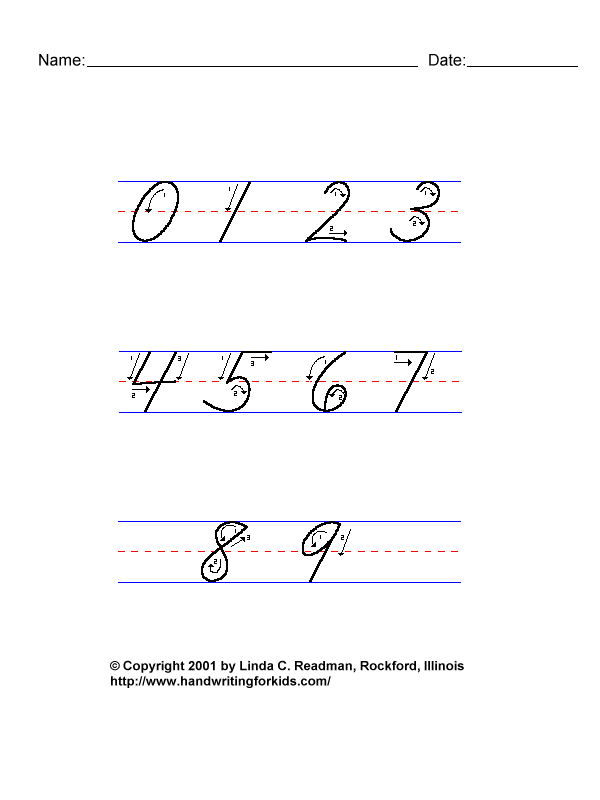
Numbers Tracing Guide
0 | 1 | 2 | 3 | 4 | 5 | 6 | 7 | 8 | 9
Animation: Numbers NEW!
See how the numbers are formed in Step-by-Step.
My Name is (BLANK - Fill In Name)
|
Non-JavaScript List | ||
The English vocabulary development activities and resources in this and related sites are based primarily on Latin and Greek elements that are included in thousands of English terms and expressions. A very small number of schools currently provide learning situations and activities that include vocabulary etymology and histories; therefore, it is advantageous for students to learn more about English development, as well as, oxymora (a.k.a. oxymorons), stories, pleonasms (redundancies), and other related terms that are provided online with this Focusing on Words program.
There are also many proverbs, legal terms, mottoes, and self-scoring quizzes, and other vocabulary activities that will help in the literary development of vocabulary proficiency so students of any age can learn these important advanced skills with the resources in these pages.
Also, be aware of the many self-testing and scoring (grading) opportunities that are available; as well as the, Latin-Greek Cross References dictionary, or lexicon, that provides thousands of vocabulary-thematic units with special search features for a greater variety of dictionary results. You may also have the advantages of another source to thousands of English words that are derived from Latin and Greek elements by clicking on this link: Latin-Greek Cross References.
To know the origin of words is to know how men think, how they have fashioned their civilizations. Word history traces the paths of human relationships, the bridges from mind to mind, and from nation to nation.
Some of the words in English can be traced to a remote past; some have histories that began yesterday or are even beginning today. Slow changes, swift new coinages of science or slang, ancient or recent borrowing from many tongues; together they give flexibility, power, and beauty to English, the richest and most widespread language of all time.
Whether you are a “native speaker” or have learned English through studies, this FREE Latin-Greek Cross References will provide you with samples of Latin-Greek elements (prefixes, roots, and suffixes) that exist in English so you will have a better idea about the main parts of the important English words.
Remember, words are the tools with which you think, communicate, and learn. The more words you know, the better you can think, communicate, and absorb knowledge; not just about English, but about everything that is important to you.
The more limited your vocabulary is, the harder survival is in our global-economic society; and certainly you want more than just to survive. It is an indisputable fact that your chances for success increase with the size and applications of your vocabulary.
Building a larger vocabulary doesn’t require you to spend hours memorizing definitions; however, it does require that you become word-conscious, that you have a curiosity about words, not only about their meanings but especially about their origins.
As stated earlier, words are the building blocks of thought. They are the means by which we understand the ideas of others and express our own opinions. It is only logical then that people who know how to use words concisely and accurately find it easier to achieve their aims.
In fact, you should realize that formal education has less relationship to vocabulary achievement than you might expect, indicating that people can improve their word power on their own. This and the related linking sites will show you how to expand and to improve your English vocabulary skills. Now, it is up to you to take advantage of these rich vocabulary resources!
Quizzes to Help You Learn and Review Vocabulary
This is a part of The Internet TESL Journal's Activities for ESL Students
Translation is an activity comprising the interpretation of the meaning of a text in one language — the source text — and the production of a new, equivalent text in another language — called the target text, or the translation.
Traditionally, translation has been a human activity, although attempts have been made to automate and computerise the translation of natural language texts — machine translation — or to use computers as an aid to translation — computer-assisted translation.
The goal of translation is to establish a relationship of equivalence and intent between the source and the target texts (that is to say to ensure that both texts communicate the same message), while taking into account a number of constraints. These constraints include context, the rules of grammar of the source language, its writing conventions, its idioms and the like.
Dr. Ramakanta Sahu |
|
|
 Under the patronage of Prof. (Dr.) Saleh Ali Bassurah, Rector, Sana’a University, a 2-day symposium on the theme “Theory of Translation for Pedagogic Purposes” was organized on 30 and 31 December, 2003 at the Department of English, Faculty of Languages. The saliency of the theme in the present context attracted large scale participation from across the Republic of Yemen. Prof. (Dr.) Saleh Ali Bassurah, Rector, Sana’a University and Prof. (Dr.) Mohammed Mutahar, Vice Minister, Higher Education graced the occasion as Inaugurator and Chief guest, respectively. Prof. (Dr.) Tariq Al-Jenabi presided over the inaugural ceremony. Under the patronage of Prof. (Dr.) Saleh Ali Bassurah, Rector, Sana’a University, a 2-day symposium on the theme “Theory of Translation for Pedagogic Purposes” was organized on 30 and 31 December, 2003 at the Department of English, Faculty of Languages. The saliency of the theme in the present context attracted large scale participation from across the Republic of Yemen. Prof. (Dr.) Saleh Ali Bassurah, Rector, Sana’a University and Prof. (Dr.) Mohammed Mutahar, Vice Minister, Higher Education graced the occasion as Inaugurator and Chief guest, respectively. Prof. (Dr.) Tariq Al-Jenabi presided over the inaugural ceremony.The event started off with a recitation from the Holy Quran by Mr. Amer Al-Mikhlafi. Welcoming the Hon’ble Vice Minister, the Rector and the delegates, Prof. Tariq Al-Jenabi, Dean, Faculty of Languages lauded the efforts of the English Department for organizing the symposium, thanks to the active help and generous support of Prof. Basurrah, Rector. Briefing on their future agenda of action he said that the Faculty mooted plans of bringing out an academic journal in foreseeable future, setting up a Centre for Translation Studies and opening up instructional facilities in Italian. He expressed the hope that the symposium would go a long way for the extension and augmentation of translation studies and research in the Republic. In his inaugural address Dr. Bassurah underscored the need and importance of wider dissemination of ideas in diverse disciplines including science, technology and literature in the present age. He particularly stressed the significance of acquisition of languages of wider communication which could lend leverage to accelerate the wheel of progress, especially at a time when creating a language competent society is a top national priority. He congratulated the Faculty for pioneering a movement in the right direction. Dr. Mutahar, Hon’ble Vice Minister while expressing his happiness to participate in the symposium characterized translation as an invaluable instrument to forge better understating among countries and cultures. It is an efficient vehicle to effect a transfer of a burgeoning body of knowledge. Translation faithfully and efficiently embodies the doctrine enshrined in the Holy Quran which exhorts people to learn from one another. Drawing upon a wealth of findings of international projects, he gave a passionate call to the academic community to make an all-out, concerted effort for the revitalization of language teaching programs. Prof. A.K. Sharma, Head of English Department, in his address iterated their resolve to carry on the continual evaluation and need-based restructuring of the curriculum on translation. He then proceeded by way of a curtain-raiser to present an overview of the theoretical underpinnings of translation as an academic discipline and its pedagogic exploitability. He focused on the need to develop parameters for a comprehensive, progress-controlled, phased teaching framework, to build up a system of teaching-learning targets, and on that basis, to design teaching-learning materials for use in translation pedagogy. He ardently hoped that the deliberations of the symposium would serve to provide fresh theoretical perspectives, formulate practical guidelines, and provide a veritable roadmap for a well directed, cost-effective translation pedagogy in the Republic of Yemen. The Inaugural session concluded with a vote of thanks by Dr. Jenabi. The first business session was kick started by an illuminating and highly stimulating presentation by Prof. Abdel Rahman Abdrabou. Prof. D. Thakur, Sana’a University, chaired the session and Prof. Abdullah Fadel Farreh, Aden University, was the Chief Guest. Prof. Abdurabou described translation as a creative process. The act of translation doesn’t merely involve text duplication. It’s indeed a process of text transformation that subsumes text assimilation and discourse processing. He called for a more informed approach to hammer out a cost-effective course that sensitizes the learners in the knowledge and skills of translating the sense and the idiom of the text. It was high time we took concrete steps to reverse the process of institutional failure in this respect and devised ways and means of exploiting the rich resource of literature to enrich the linguistic competence of a vast majority of EFL learners, equipping them to use English as a research tool and a library language. The second presentation of the session was by Prof. K.M. Tiwari of Taiz University. Building up a contrast between the popular and academic modes of translation Prof. Tiwari illustrated how all translations borrow meanings from other languages, and we, without any conscious awareness, yet driven by pragmatic communicative needs, incarnate them with new shades of meanings. All borrowings tend to undergo alternations, both in sense and form, at the incipient stage. All borrowing in translation is slow movement. Academicians interested more in theoretical principles and i
The next speaker, Prof. Aziz Yousif Al Muttalibi of Aden University, presented his paper on “Literary Translation as a Semiotic Act.” He elucidated the semiotic dimensions of a codic ‘context’ where communicative transactions, pragmatic actions and semiotic interactions operated and which interplay with and override the other dimensions. The texture of poetry is spoiled in translation which accounts for the untranslatability of poetry. He characterized the translator as a ‘cruel man’, a ‘constructive demolisher.’ Prof. Al Muttalibi made plea for a synthetic-analytic approach in translation. The last speaker of the session Prof. A.K. Sinha, Taiz University, focused on the phenomenon of semantic shift in translation of lexical items. With the help of a number of neologisms and metaphorical use of several existing terms he highlighted the role and relevance of the Prototype theory for the purpose of finding equivalence in translation. In his presidential remarks Prof. D. Thakur drew a clear line of demarcation between translation and translatolgy. He drew an analogy between a translator and an actor. The distance between the translator and the text is same as that between ‘me’ and ‘not me.’ A Translator’s job is not merely a mechanical pulling of parts, but achieving a dynamic togetherness as well as identifying the ‘etymon’, the life spirit. A translator’s genuine concern should be transcreation. The second business session was presided over by Prof. Abdelrahman Abdrabou with Prof. K.M. Tiwari as the Chief Guest. The first speaker Prof. Panchanan Mohanty, Dhamar University in his presentation titled “What Can Translation Theory Learn from Medicine Wrappings and Street-side Hoardings” perceived translation out and out as a language activity which is not unitary, but composite. Translation theory should cease being prescriptive with a top-down approach and embody, instead, a bottom-up approach. There is no perfect translation. With the help of the result of an analysis of 87 medicine wrappings and roadside hoardings involving Arabic and English, he called in question certain key concepts of prescriptive translation and advocated adoption of a descriptive approach. This was followed by a paper “Towards a Discursive Socio-Semiotic Interpretation of Problems of Cultural Untranslatability” by Dr. Anil K. Prasad, Ibb University. Dr. Prasad dwelt upon the embedded semantic indeterminacy leading to problems of cultural untranslatability and how sociosemiotics can offer a solution to the problems and issues involved. He alerted the actual and potential translators against over- an under-translation and called for a socio-semiotic approach to translation to reduce its baffling complexion. A translator needs to be equipped with a set of appropriate manipulation and interpretation strategies in his attempt to reconcile the irreconcilable within the constraints of accuracy and acceptability. The third presentation of the session was by Prof. Nand Kishore Pandey, Taiz University. He demonstrated how translation is essentially an enigmatic process, especially if it comes to translation of a poem. His attempted translation of an English poem into the Arabic idiom proved beyond doubt that all translation is only an attempt at approximation to the original. The concluding presentation of the session by Ms. Wasom Fathi, Hodeidah University, on the topic “The Meaning or the Equivalent” was an attempt to grapple with the concept of equivalence as distinguished from ‘meaning’. She identified some aspects of language, finding equivalence for which is fraught with problems of varying magnitude. This problem can potentially be addressed by developing itemized listing of lexical items with culturally appropriate equivalents. In his concluding remarks, Prof. Abdurabou, Chairperson, expressed his considered view that no professional translator can boast of having translated all the subtle nuances of a text. More often than not, a translator is filled with a sense of incompetence rather than accomplishment in tackling the baffling enterprise. The first session of the second and concluding day of the symposium was chaired by Prof. K.V. Tirumalesh, Faculty of Languages. Prof. Aziz Yousif Al Muttalibi was the Chief Guest. Prof. Abdullah, the first speaker of the morning in his presentation “Literary Translation as a Semiotic Act” traced the primary role assigned to translation in Aden, the focal point of learning during the period of British colonialism. The next presentation was by Dr. M.N.K. Bose, Ibb University. In his paper “Translation for Empowering the Learners in English Classes: Teaching Reading through Translation,” Dr. Bose critically evaluated the socio-cultural context in Yemen
The third speaker Dr. Abdul Majid Joodi, Faculty of Languages, in his paper “A Study of Problems of Learning and Translating Idioms” highlighted some of the crucial problems of appropriate contextual use of idioms, one of the slippery areas of English. He explained how the unit of meaning of idioms is more than the sum of the meaning of its parts and the difficulties involved in the translation of idioms. In so far as idioms are culture-specific, translation of idioms may be percieved as an act of betrayal. In his paper titled “Science Through Translation” Dr. Rajiv Kumar Mallik, Faculty of Arts, Sana’a University, delved deep into the problems of translating registers. Citing examples of loan translation, he lucidly underscored the importance of looking at this type of translation from the point of view of cultural untranslatability. Dr. Abdulsalam Al-Ghrafy, Faculty of Languages, Sana’a University, the next speaker, in his presentation “Untranslatability of Some Writing Conventions from English to Arabic” give an exposition of the translatability and untranslatability of writing conventions in different languages which are divergent genetically. The speaker advocated evolving a set of comprehensive strategies involving graphological and stylistic conventions across languages to obviate this problem. The post-tea session began with the presentation captioned “The Translator as Sceptic” by Dr. Murari Prasad, Faculty of Education and Arts, Sada’a, in which he looked at the skeptical process and program as an enabling template for resolving some of the conundrums of translation which is primarily cultural mediation. He analyzed the problems and prospects of opening common ground between disjunct cultures. Characterizing translation as an enterprise that involves bridging as well as re-constructing the subjectivities of the host culture to facilitate cross-cultural communication, he argued that a translator should aim at ‘equipollent’ rendition of the source text, not merely its equivalent conversion, or pale wooden paraphrase for that matter, through inter-systemic manipulation.Fittingly, he pointed out the subtle distinctions between ‘auto-translation’(bilingual execution by the same author) and ‘transcreation’, between’crib’ and ‘dynamic equivalence’, and maintained that translation is a creative deviation whereby the translator taps the alternative potential of the text within an alien semiotic frame while conforming to semantic equivalence. Dr Prasad also outlined some of the recent advances in the discipline , such as Skopos theory, Polysystems theory and grammatological theory of translation, to contend that contemporary translation studies and practice are getting increasingly influenced by postcolonial cultural studies and the disciplines proliferating around it. Notably in addition,he called for a reassessment of the protocols of translational practice which are more often than not over-determined by cultural politics on a grade of reception. This was followed by the paper “Conceptual Translation of Invention Terms into English” by Dr. Talib Abdul Rahman, Professor of Arabic, Faculty of Education, Khawlaan. Briefly outlining the strategies of phonological adaptation, literal or conceptual translation at the disposal of Arabic in encountering English and French words denoting new inventions, Prof. Talib focused on the conceptual translation and explored the connection between the concept, or the new invention itself, on the one hand, and the term used to designate it, on the other. The last paper in the pre-lunch session titled “Semiotics and the Translation of Terrorism” was by Dr. Khalid Al-Shehari, Sana’a University. He identified terms which are transparent and those which defy an easy translatability. The study advocated a thorough consideration of the qualities and values that would empower the translator to retain the target reader’s cultural identity and ideology and defined the role of semiotics in relating the translator to curriculum designer, materials producers as well as the target readership. The session concluded with a note of appreciation by the Chief Guest and the President for the illuminating presentations which together demonstrated the multiplicity and variety of perspectives from which translation can be studied. However, the practicalities of the enterprise should not be lost sight of in the orthodoxies of theory galore. In the last business session, presided over by Prof. (Dr.) Ali Mansoor, Dr. U.K. Mishra in his paper “Second Language Learning and Translating: A Perspective” assessed the fac
The next presentation titled “What Does a Trainee Translator Need” by Dr. Aid Sharyan, Faculty of Education, Sana’a University, was an attempt to pin down the pre-requisites of a translator in discharging, with passion and professionalism, the range of roles he is called upon to perform. Correspondingly, the trainer-translator needs to sensitize himself with a plethora of practical techniques to explode the myth that translation is an act of betrayal and the translator is a betrayer who can never be faithful to the original. Dr. Ayid came out with a practical suggestion to set up a ‘Translators’ Guild’ to streamline all translation activities in Yemen and evolve an integrative approach to the challenges confronting it. Dr. Sharyan’s suggestion was hialed by the members of the audience. The third speaker Dr. Ahmed Mohammed Al Quyadi, Faculty of Education, Sana’a University in his presentation “Translation Teaching at the Yemen Universities: Conditions and Prospects” analyzed the factors leading to learners’ dislike of translation, one of which is a lack of linguistic competence on their part including the knowledge about cohesive devices in English which are the nuts and bolts of the language. The teacher of translation has a significant role in sensitizing the learner about the discourse types and in sharpening his skill in translation. Dr. Saleh Ahmed Saif, Faculty of Language, the last speaker of the session is his paper “Contrastive Linguistics and the Teaching of Translation” identified the common ground between the two enterprises and discussed how each can draw insight from and contribute towards the enrichment of the other. Prof. Monsour, the Chair and Dr. A.K. Sinha, the Chief Guest, summed up the main threads of argument in the presentations. The valedictory ceremony began with Dr. Tariq Al-Jenabi, Dean on the chair. Dr. D. Thakur graced the occasion as the Chief Guest. Dr. Jenabi, while expressing his deep sense of appreciation for the active participation of everyone which made the event a resounding success, hoped that deliberations would go a long way to put in a clearer perspective some of the hazy theoretical concepts and help formulate a feasible action plan for the future. Prof. Thakur in his valedictory address upheld the universal value of harmony which lay at the heart of all texts, the task of the translator being to unravel that harmony. Translation, he said, is not only a skill but a great art that is embellished by intuitive introspection. A translator, like a poet, is a creator. He called upon the students to cultivate a sustained, continued assimilative exposure to texts. Prof. Thakur characterized translation as a great unifying force to bridge the artificial divide that is corroding the human psyche at present. Dr. Shamser, Vice Dean, Faculty of Languages, proposed a vote of thanks. On the suggestion of Prof. A.K. Sharma, a committee was formed under the chairmanship of Prof. Abdel Rahman A. Abdrabou. Other members who were nominated to the committee are the following: 1. Dr. Mahmood Ali Shamser 2. Dr. Abdul Majeed Joodi 3. Dr. Ayed Sharyan 4. Prof. (Dr.) Abdullah Fadel Farreh (Consultant) As the annual academic jamboree drew to a close, there was a sense of fulfillment, of accomplishment. Everyone had something to reflect on, something to look forward to. The message that trickled through the 2-day congregation was clear: Translation is an ongoing, creative process. It is never finished, although it is temporarily abandoned. As such, the ‘exhaustive fallacy’ of translation is a myth. In fact translation is an impeccable instrument of empowerment, an unfailing means for a dynamic interaction between peoples, languages and cultures. It is a unique symbol of a progressive idealism whose lofty aim is to achieve a multilingual, multicultural confluence. The deliberations of the symposium refreshed the minds of participants and opened vistas of understanding relating to the concept of translation. There seemed to be a tacit consensus and a firm commitment to explore new horizons of translation and redefine the frontiers of translation pedagogy. The rapporteurs Dr. R. K. Sahu, Dr. U. K. Mishra, Dr. R. K. Mallik, Dr. Rajesh Kumar, Dr. Khalid Al-Asbahi, and Dr. Mohammed Othman Naif perseverantly compiled and consolidated a report on the proceedings of the symposium. |
we believe that for a translation to be adequate it must be
Good theory is based on information gained from practice. Good practice is based on carefully worked-out theory. The two are interdependent. (Larson l991, p. 1)
The ideal translation will be accurate as to meaning and natural as to the receptor language forms used. An intended audience who is unfamiliar with the source text will readily understand it. The success of a translation is measured by how closely it measures up to these ideals.
The ideal translation should be…
Translation is a process based on the theory that it is possible to abstract the meaning of a text from its forms and reproduce that meaning with the very different forms of a second language.
Translation, then, consists of studying the lexicon, grammatical structure, communication situation, and cultural context of the source language text, analyzing it in order to determine its meaning, and then reconstructing this same meaning using the lexicon and grammatical structure which are appropriate in the receptor language and its cultural context. (Larson l998, p. 3)

Diagram from Larson l998, p. 4
In practice, there is considerable variation in the types of translations produced by translators. Some translators work only in two languages and are competent in both. Others work from their first language to their second language, and still others from their second language to their first language. Depending on these matters of language proficiency, the procedures used will vary from project to project. In most projects in which SIL is involved, a translation team carries on the project. Team roles are worked out according to the individual skills of team members. There is also some variation depending on the purpose of a given translation and the type of translation that will be accepted by the intended audiences.
Books by SIL authors that present translation theory and practice include the following which are available on line at the International Academic Bookstore. There are also many articles on translation theory and practice listed in the SIL bibliography.
Of interest to all professional translators:
Callow, Kathleen, l999, Man and Message
Gutt, Ernst-August, l992, Relevance Theory
Larson, Mildred L., Meaning-based Translation (Also in Indonesian, Spanish, and Russian.)
Of special interest to Bible Translators:
Barnwell, Katharine, l986, Bible Translation (Also in French and Russian)
Larson, Mildred L., with Ellis E. Deibler and Marjorie Crofts, l998, Meaning-Based Translation Workbook: Biblical Exercises
 Larson, Mildred L., editor. 1991. Translation: theory and practice, tension and interdependence. American Translators Association scholarly monographs, 5. Binghampton, NY: State University of New York. 270 p.
Larson, Mildred L. 1998. Meaning-based translation: A guide to cross-language equivalence. Lanham, MD: University Press of America and Summer Institute of Linguistics. x, 586 p.
| ۸۴۱۹۳۶۱۵ | غ |
| ۸۴۱۹۳۸۴۰ | ۱۰ |
| ۸۴۱۹۳۳۹۷ | ۱۶ |
| ۸۴۱۹۲۹۰۴ | ۱۳ |
| ۸۴۱۹۲۴۴۴ | ۱۷ |
| ۸۴۵۶۹۸۷۰ | ۱۶ |
| ۸۴۱۹۲۴۴۶ | ۱۶ |
| ۸۴۵۳۱۷۷۰ | ۱۵ |
| ۸۴۵۶۰۸۴۱ | ۱۳ |
| ۸۴۱۹۳۱۵۱ | ۱۴ |
| ۸۴۵۴۶۳۱۲ | ۱۳ |
| ۸۴۵۲۳۱۱۸ | ۱۲ |
| ۸۴۵۷۳۲۲۵ | ۱۵ |
| ۸۴۵۰۳۶۹۸ | ۱۷ |
| ۸۴۴۸۷۹۷۷ | ۱۳ |
| ۸۴۵۲۸۵۶۴ | ۱۴ |
| ۸۴۴۷۳۰۳۰ | ۱۰ |
| ۸۴۳۹۳۵۴۴ | ۱۴ |
| ۸۴۱۹۳۲۹۴ | ۱۲ |
| ۸۴۵۳۹۱۵۴ | ۱۱ |
| ۸۴۵۵۷۸۰۶ | ۱۶ |
| ۸۴۱۹۲۴۰۰ | ۱۴ |
| ۸۴۴۴۷۱۰۳ | ۱۲ |
| ۸۳۱۸۸۶۰۰ | ۱۴ |
| ۸۴۵۴۹۳۱۵ | ۱۶ |
| ۸۴۵۲۸۵۶۳ | ۱۲ |
| ۸۳۱۸۸۵۶۹ | ۱۸ |
| ۸۴۱۹۳۸۴۳ | ۱۸ |
| ۸۴۱۹۴۹۵۲ | ۱۰ |
| ۸۴۵۳۳۵۷۴ | ۱۰ |
| ۸۴۵۷۰۵۹۰ | ۱۲ |
| ۸۴۵۲۶۳۶۳ | ۱۹ |
| ۸۴۵۵۹۲۰۱ | ۱۰ |
| ۸۴۵۵۷۰۹۴ | ۱۲ |
| ۸۳۱۸۸۶۲۳ | ۱۴ |
| ۸۴۱۹۱۹۸۸ | ۱۸ |
| ۸۴۵۶۸۴۵۴ | ۱۳ |
| ۸۴۵۰۷۰۷۷ | ۱۷ |
| ۸۴۱۹۲۳۱۰ | ۱۲ |
| ۸۴۳۲۹۹۶۹ | ۱۹ |
| ۸۴۳۴۴۶۵۷ | ۱۹ |
| ۸۴۳۷۷۷۶۰ | ۱۹ |
| ۸۴۴۶۹۰۵۱ | ۱۴ |
| ۸۴۴۳۱۱۲۸ | ۱۶ |
| ۸۴۴۹۱۴۰۷ | ۱۸ |
| ۸۴۴۴۵۷۲۴ | ۱۴ |
| ۸۴۱۸۸۱۰۶ | ۱۶ |
| ۸۴۲۲۲۶۵۹ | ۱۷ |
| ۸۴۲۸۷۱۲۹ | ۱۹ |
| ۸۴۱۸۸۱۲۴ | ۱۴ |
| ۸۴۴۷۶۲۷۰ | ۱۳ |
| ۸۴۴۰۱۱۱۵ | ۱۴ |
| ۸۴۴۴۸۹۳۹۴ | ۱۶ |
| ۸۴۳۲۶۷۳۰ | ۱۷ |
| ۸۴۳۹۷۱۷۹ | ۱۶ |
| ۸۴۳۶۰۲۵۸ | ۱۵ |
| ۸۴۵۷۳۹۸۴ | ۱۸ |
| ۸۴۳۵۲۰۲۰ | ۱۶ |
| ۸۴۳۷۶۶۸۸ | ۱۶ |
| ۸۴۳۷۸۶۵۴ | ۱۶ |
| ۸۴۴۷۱۸۲۵ | ۱۱ |
| ۸۴۴۷۶۵۲۹ | غ |
| ۸۴۳۶۴۷۸۳ | ۱۷ |
| ۸۴۲۶۵۴۰۹ | ۱۸ |
| ۸۴۱۸۸۱۰۳ | ۱۶ |
| ۸۴۳۰۵۰۸۹ | ۱۴ |
| ۸۴۳۱۳۳۶۰ | ۱۸ |
| ۸۴۲۵۲۲۲۱ | ۱۸ |
| ۸۴۳۰۲۳۴۱ | ۱۶ |
| ۸۴۱۸۸۱۱۳ | ۱۹ |
| ۸۴۴۶۲۷۹۰ | غ |
| ۸۴۴۵۸۷۲۰ | ۱۶ |
| ۸۴۲۸۹۶۰۴ | ۱۴ |
| ۸۴۴۷۸۱۲۰ | ۱۶ |
| ۸۴۴۴۸۰۳۹ | ۱۶ |
| ۸۴۴۹۵۴۳۲ | ۱۸ |